

Cutting Machinery
Henan Yugong Machinery Co., Ltd: Your Professional Cutting Machinery Manufacturer!
Henan Yugong Machinery Co., Ltd. is a large-scale comprehensive enterprise integrating engineering research and development, production and sales. The company has developed rapidly over the years and has become an excellent product manufacturer in the engineering machinery industry.
Wide Application
Our company has 8 product series and more than 100 products, covering industries such as bridges and tunnels, roads, light rail and high-speed rail, and mines.
Quality Assurance
All YG products we produce are certified by ISO, SGS, CE, EPA, etc.
Broad Market
Our customers are all over the world, with more than 100 countries such as the United Kingdom, France, Italy, Spain, South Africa, Africa, Japan, etc.
Leading Service
Our service pursues refinement and standardization. From pre-sales technical consultation to after-sales maintenance, we always put the interests of customers first and provide customers with meticulous and thoughtful services.


Cutting Machinery are pieces of industrial or commercial manufacturing equipment used to cut materials into specific shapes. They can cut everything from paper and fabric to rubber, foil, foam, and even sheet metal.
Fast And Efficient
One of the main advantages of the Cutting Machinery is its fast and efficient cutting ability. Compared with traditional manual cutting, the Cutting Machinery can greatly reduce the cutting time and greatly improve the production efficiency. In addition, the Cutting Machinery with a high degree of automation can also complete multiple cutting tasks at one time, which is more efficient and convenient.
High Precision
The Cutting Machinery adopts an advanced digital control system to achieve high-precision cutting operations. Based on the advanced swing arm or gantry structure design, the cutting head can maintain accurate position and trajectory during processing, thereby achieving high-precision cutting of standard materials. This is very critical in some important processing links.
Wide Applicability
The Cutting Machinery is suitable for cutting various materials, whether it is metal or non-metallic materials, the Cutting Machinery can easily cut. At the same time, it can also be cut in different ways, such as jet cutting, laser cutting, plasma cutting, etc. This variety of cutting methods is more in line with the needs of different industries.
Wide Application
The Cutting Machinery has been widely used in many industries. In the interior decoration industry, the Cutting Machinery can make a variety of high-quality decorative materials; in the manufacturing industry, the Cutting Machinery, as a core equipment, can be used for the production of mechanical parts; in the construction industry, the Cutting Machinery can be used to process various construction and garden materials, etc. With the continuous development of science and technology, the application areas of Cutting Machinerys will become more extensive.
Hydraulic Wire Saw
Description
Hydraulic Wire Saw is a flexible method of cutting masonry, concrete, granite and other substrates, including steel. It is particularly useful when extremely thick and/or awkward shapes need cutting. It is an ideal tool for cutting and removing reinforced concrete, such as bridge sections, jetties, columns or beams. The Wire sawing rig is available with either a 3 Phase or Petrol powered hydraulic power pack.
Benefits
● High Cutting Efficiency: The hydraulic wire saw has high cutting efficiency. Traditional manual cutting tools consume a lot of manpower and time, while the hydraulic wire saw can complete the cutting task quickly and accurately. Its cutting speed can reach more than meters per minute, which greatly improves work efficiency.
● High Cutting Accuracy: The hydraulic wire saw has high cutting accuracy. The hydraulic wire saw uses high-strength wire rope as a cutting tool, which can be cut in a small space without affecting the surrounding environment. At the same time, the hydraulic wire saw can also be adjusted according to different cutting requirements, and can achieve a variety of cutting methods such as straight cutting, arc cutting, and oblique cutting.
● High Safety: Third, the hydraulic wire saw has high safety. The hydraulic wire saw uses hydraulic power to avoid safety hazards such as electric shock and sparks. During use, the control of cutting speed and adjustment of cutting direction can also be used to avoid accidents and ensure the safety of staff.
● Adaptability: The hydraulic wire saw has good adaptability. The hydraulic wire saw can be used for cutting various materials, including steel, concrete, stone, wood, etc. In special circumstances such as field survey and rescue, hydraulic wire saw can also play its unique role.
Hydraulic Wall Saw
Description
Hydraulic Wall Saw employs a circular blade on a track-mounted machine. The track is attached to horizontal walls or steep inclines that will not permit the use of flat saws. Wall or track sawing is typically specified to cut precise dimensional door, vent and window openings.
Benefits
● Efficient And Fast: The Hydraulic Wall Saw has a fast cutting speed and can quickly and easily cut pile heads, concrete and other materials into the required size, significantly improving construction efficiency.
● Stable And Reliable: The Hydraulic Wall Saw is driven by hydraulic power and has a high-power motor that can provide stable cutting force and rotational speed to ensure uniform cutting results and smooth pile head cutting. The hydraulic power transmission method ensures smooth work, reduces vibration and impact, and extends the service life of the saw chain.
● Safe Operation: Hydraulic Wall Saws are designed for safe and reliable operation. It uses a hydraulic motor to transmit power without direct contact with the cutting part, reducing the risk of operator injury. Some Hydraulic Wall Saws are equipped with safety protection devices, such as overload protection, automatic stop, etc., which further improves operational safety.
● Strong Adaptability: Hydraulic Wall Saws are suitable for cutting various types of pile heads, concrete, rocks and other materials. Whether they are round, square or other special-shaped pile heads, they can effectively cut them. The cutting angle and depth can be adjusted according to actual needs to meet the needs of different projects.
● Excellent Technical Parameters: Hydraulic Wall Saws usually have a high rated spindle speed, such as ≥5000r/min, ensuring high-speed cutting efficiency. Parameters such as the maximum length of the saw board and the maximum cutting depth are also relatively large. For example, the maximum length of the saw board is ≥43cm and the maximum cutting depth is ≥40cm. It is suitable for cutting various large workpieces.
● Easy Maintenance: The maintenance of Hydraulic Wall Saws is relatively simple. Only wearing parts such as saw chains and hydraulic oil need to be replaced regularly to ensure the normal operation of the equipment. The stability and reliability of the hydraulic system also reduce the failure rate and reduce maintenance costs.
● Environmental Protection And Energy Saving: Hydraulic Wall Saws produce less noise and vibration during work, and have less impact on the environment and operators. Using degradable and environmentally friendly chain saw oil can reduce environmental pollution and comply with environmental protection requirements.
Integrated Drill and Splitting Machine
Description
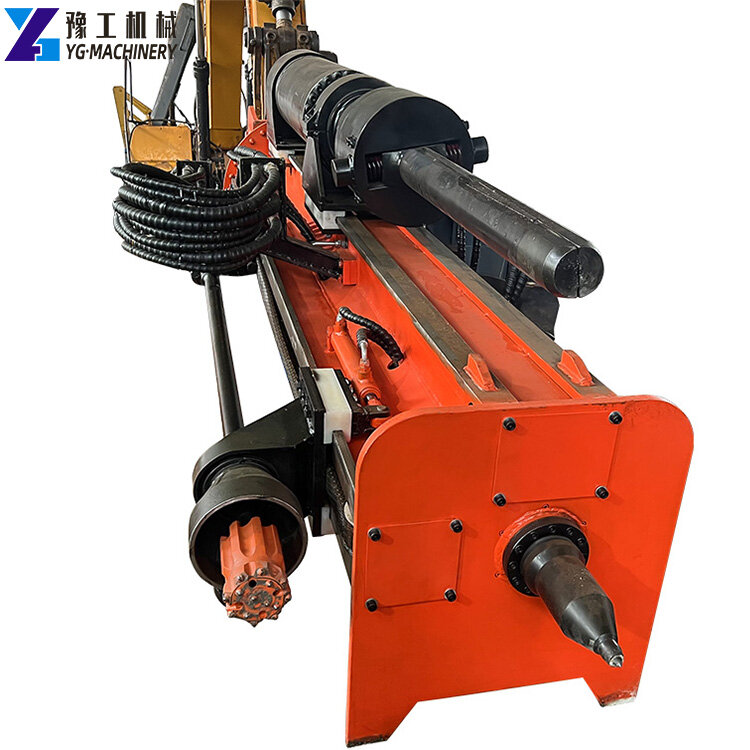
The Integrated Drill and Splitting Machine is a powerful tool for the construction and demolition industry, creating precise holes and splitting in a variety of hard rocks. This machine combines the two processes of drilling and splitting into one device to save time and increase efficiency on the job site.
Working Principle
● Integrated Drill and Splitting Machines typically use an electric motor connected to a spindle to rotate a cylindrical cutting tool on its axis and drives the tool’s sharp end into a workpiece, often with considerable force, and hopefully with good accuracy in position and entry angle. The ability for Integrated Drill and Splitting Machines to quickly and precisely drill holes with minimal setup time is in large part what makes them useful to have around.
● It’s important that the workpiece be securely held in place on the machine table, because if it gets free it will spin with a lot of speed and can cause serious damage. How the workpiece is retained varies widely, from ad-hoc clamping to high quality X-Y moved vices and work chucks, which some models include.
● Generally, Integrated Drill and Splitting Machines are oriented with the spindle vertical, but some are constructed to drill horizontally. In many cases, the angle to the quill (the axis drive of the spindle) can be adjusted and locked, to drill holes that are non-perpendicular to the table. This reorientation greatly increases the applicability of a Integrated Drill and Splitting Machine to more varied tasks.
Rock Splitter for Excavator
Description
The Rock Splitter for Excavator is a large hydraulic rock splitter that can be hoisted on an excavator. It uses the internal hydraulic system of the excavator as the driving force, and uses the physical and mechanical properties of rock, which has a much greater compressive strength than tensile strength, to apply the wedge principle to destroy the structure of the rock from the inside and split the rock in a predetermined direction.
Applications
● Mining Field: Rock Splitter for Excavator can be used for mining of mine stone, such as granite, marble, sandstone, limestone, etc. It can be used for mining of metal mines, non-metallic mines, and coal mines. It can be used for mining of large blocks of stone: it can realize secondary splitting and breaking of a block of several thousand cubic meters. It can be used for segmentation of large blocks of stone: it can realize splitting of blocks below 1 cubic meter. It can be used to remove large pieces of waste stone, dead corners, obstacles, leveling sites, etc.
● Engineering Field: Rock Splitter for Excavator is widely used in municipal foundation and urban construction. It can be used for earthwork excavation projects: roads and bridges, houses, foundations, reinforced concrete demolition and other projects. It can be used for tunneling projects: subways, culverts, mines, underground pipelines, river management and other projects. It can be used for smelting and demolition projects: crushing and demolition of various smelting furnaces, kilns, refractory bricks, and carbon blocks.
● Disaster Relief Field: Rock Splitter for Excavator can also be used for pretreatment of rock blasting to achieve better blasting effect. It can be used for disaster relief and rescue in earthquakes, landslides, roads, railways, and traffic accidents, etc.
Certifications


Frequently Asked Questions
As one of the most professional cutting machinery manufacturers and suppliers in China, we're featured by quality products and competitive price. Please feel free to buy cheap cutting machinery for sale here from our factory.