

DTH Drilling Rig
Henan Yugong Machinery Co., Ltd: Your Professional DTH Drilling Rig Manufacturer!
Henan Yugong Machinery Co., Ltd. is a large-scale comprehensive enterprise integrating engineering research and development, production and sales. The company has developed rapidly over the years and has become an excellent product manufacturer in the engineering machinery industry.
Wide Application
Our company has 8 product series and more than 100 products, covering industries such as bridges and tunnels, roads, light rail and high-speed rail, and mines.
Quality Assurance
All YG products we produce are certified by ISO, SGS, CE, EPA, etc.
Broad Market
Our customers are all over the world, with more than 100 countries such as the United Kingdom, France, Italy, Spain, South Africa, Africa, Japan, etc.
Leading Service
Our service pursues refinement and standardization. From pre-sales technical consultation to after-sales maintenance, we always put the interests of customers first and provide customers with meticulous and thoughtful services.


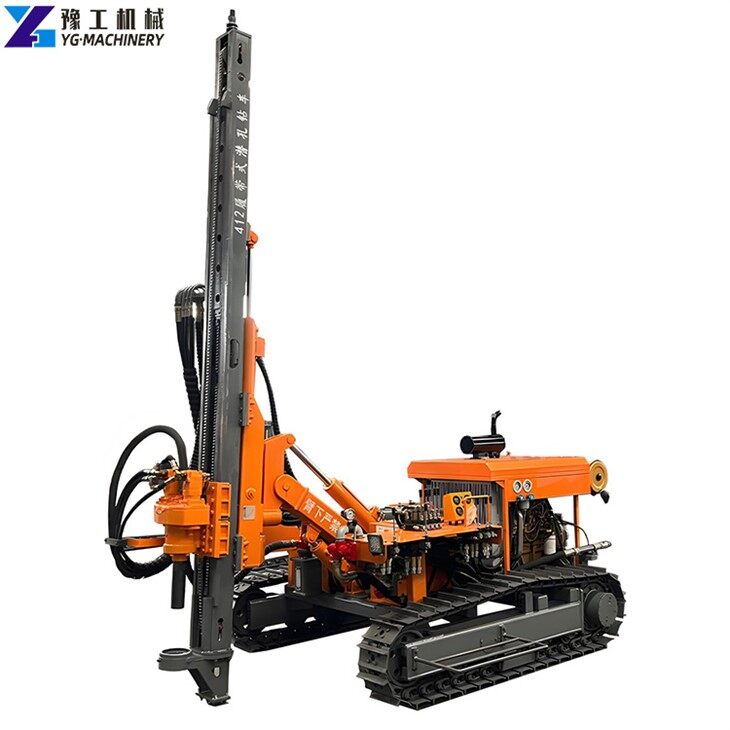
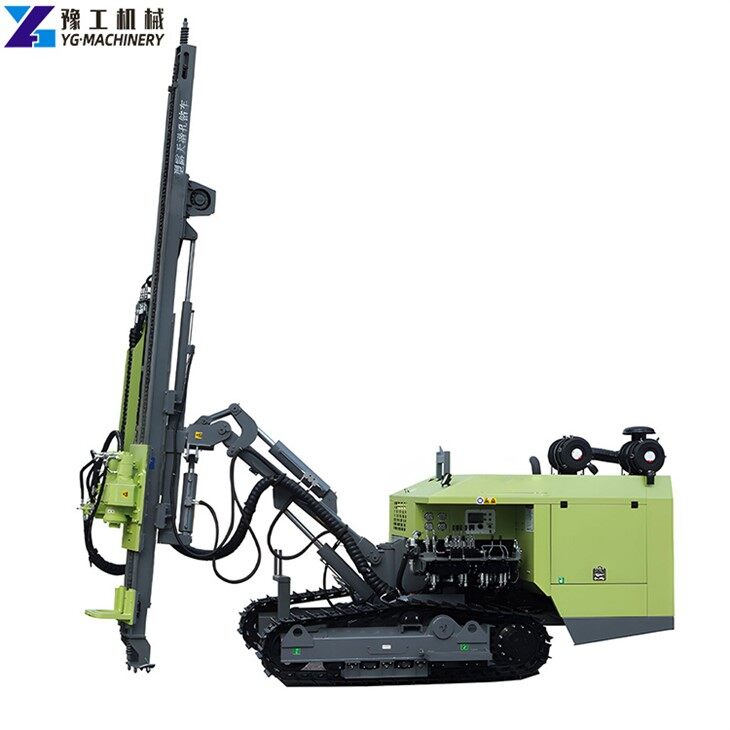
A DTH Drilling Rig, usually called DTH by most professionals, is basically a jackhammer screwed on the bottom of a drill string. The fast hammer action breaks hard rock into small cuttings and dust that are evacuated by a fluid (air, water or drilling mud).
Features of DTH Drilling Rig
High-Efficiency Drilling Capability
DTH drill rigs use down-the-hole hammer technology, where the drill bit operates directly at the bottom of the hole. By transferring power through gas or liquid to the drill bit, they achieve efficient impact and rotation. This design not only increases drilling speed but also significantly reduces energy loss, making the drilling process more efficient.
Outstanding Stability
DTH drill rigs are highly stable and can operate efficiently in complex and harsh geological environments. Their robust structure and advanced control systems ensure stable operation in various soil conditions, preventing issues like hole deviation and collapse.
Precise Control
Modern DTH drill rigs are equipped with advanced hydraulic and electronic control systems, allowing operators to precisely control drilling parameters. Drilling depth, angle, and speed can be adjusted flexibly according to actual needs, enhancing drilling accuracy and efficiency.
Low Energy Consumption Design
DTH drill rigs adopt energy-saving designs, optimizing power transmission and minimizing unnecessary energy losses. This not only reduces operating costs but also lessens environmental impact, meeting modern environmental protection requirements.
Ease of Maintenance
The modular design of DTH drill rigs simplifies maintenance and upkeep. Key components are easy to disassemble and replace, reducing downtime and ensuring efficient operation. Additionally, many DTH drill rigs feature automatic diagnostic systems that monitor equipment status in real-time, promptly identifying and addressing potential issues.
Classification by Drilling Method
● Rotary Down-The-Hole Drill
A rotary down-the-hole drill is a down-the-hole drill that rotates the drill rod to make the drill bit drill. This type of down-the-hole drill is used for construction in most cases.
● Impact Down-The-Hole Drill
An impact down-the-hole drill uses impact force to make the drill bit penetrate and drill holes. It is suitable for environments with relatively large drilling stress.
● Extrusion Down-The-Hole Drill
An extrusion down-the-hole drill is a down-the-hole drill that squeezes the drill bit down to drill holes. It is particularly suitable for drilling operations in water layers.
Classification by Use Environment
● Industrial down-the-hole drill
Industrial down-the-hole drills are mainly used for foundation pouring of buildings, and the drilling depth needs to reach more than 30 meters.
● Agricultural down-the-hole drill
Agricultural down-the-hole drills are mainly used for the construction of drainage and irrigation facilities in farmland, and the general depth is about 10 meters.
● Mining down-the-hole dril
Miningdown-the-hole dril is mainly used for mine prospecting operations. This type of DTH Drill can support ultra-large diameter drilling operations.
Classification by Power
● Diesel DTH Drill
Diesel DTH Drill is powered by a diesel engine and is usually used in field operations without power supply.
● Electric DTH Drill
Electric DTH Drill uses an electric motor as power and is suitable for working environments with power supply such as construction sites and workshops.
Down-the-hole drill is a tool commonly used in construction, geology and mining, and is a type of drilling rig. It consists of multiple parts such as motor, gearbox, reducer, hydraulic station, cooling system and drilling tool system. Down-the-hole drill mainly consists of the following parts:
Drill Rod System
The drill rod system is a very important part of the down-the-hole drill. Its function is to transmit power to the drill bit. When the drill bit rotates, the drill rod also rotates. The drill rod system consists of drill rod, joint, drill bit, transmission shaft, etc.
Rotating Mechanism
The rotating mechanism is the core part of the down-the-hole drill, which can realize the rotation of the drill rod. The rotating mechanism consists of motor, reducer, coupling, transmission gear set, etc.
Hydraulic System
The hydraulic system is a very important part of the down-the-hole drill, which can drive the drilling rig to realize various operations. The hydraulic system includes hydraulic system, oil tank, oil pump, hydraulic cylinder, hydraulic valve and other parts.
Drilling Rig Base
The drilling rig base is the supporting structure of the drilling rig, which can be adjusted as needed to ensure the stability and safety of the drilling rig. The base of the drilling rig is generally composed of a motor, a reducer, a base plate, etc.
Control System
The control system is an indispensable part of the down-the-hole drill, which can control the operation of the down-the-hole drill. The control system consists of a human-machine interface, a processor, a program library, etc.
Detailed explanation of the names of the parts of the down-the-hole drill
Drill Rod
The drill rod is the part of the down-the-hole drill responsible for transmitting torque and torsional force to the drill bit. It is generally composed of two or three sections. The length of the drill rod can be adjusted according to specific needs.
Drill Bit
The drill bit is one of the most important parts of the down-the-hole drill, which is responsible for drilling. There are many types of drill bits, some of which are used to drill underground materials, some are used to drill water wells, and some are used to drill oil wells.
Drill Rod Joint
The drill rod joint is responsible for connecting two drill rods so that they can be tightly connected together to prevent oil and water leakage and ensure the smoothness of rotation.
Drive Shaft
The drive shaft is the part of the DTH drill used to transmit power. It can transmit the torque of the motor to the drill rod, so that the drill bit starts to rotate.
Hydraulic Pump
The hydraulic pump is used to provide hydraulic pressure to enable the DTH drill to work properly. The hydraulic pump is generally composed of high-pressure oil pipes, oil pumps, oil tanks, etc.
Cooling System
The cooling system is one of the important components of the DTH drill. It can cool the drill bit to avoid overheating damage. The cooling system consists of an oil-water radiator, a water pump, a water pipe, etc.
Construction Field
Down-the-hole drills are mainly used for foundation reinforcement and basement excavation in the construction field. For example, in the center of the building base or the columns that touch the base, it is necessary to go deep underground for reinforcement. With a down-the-hole drill, it is convenient to drill holes and inject concrete that can be both reinforced and waterproof at one time.
Transportation Field
In subway construction, in order to make the line pass through busy streets and buildings better, underground crossing is required. At this time, down-the-hole drills can avoid damage to the surrounding environment, reduce construction noise and impact on traffic, and improve construction quality.
Water Conservancy Field
When underground water pipes, culverts, etc. need to be repaired, reinforced or replaced, if traditional excavation methods are used, it will not only affect the surrounding environment, but also increase the construction period and cause waste of manpower and material resources. Down-the-hole drills can avoid these problems and greatly improve construction efficiency.
Mining Field
In mining engineering, down-the-hole drills can help drill deep wells or vertical wells to avoid damaging the surface and surrounding environment of the mining area. At the same time, down-the-hole drills can also conduct underground mineral deposit exploration and evaluation, helping mine managers better understand the internal situation of the mining area and improve mining efficiency and safety.
Drilling Purpose
Determine the specific purpose of your drilling project, such as water well drilling, mine exploration, geotechnical investigation, or construction. Different applications may require different types of drill rigs.
Geological Conditions
Evaluate the geological formations you will be drilling into, including the hardness, abrasiveness, and composition of the rock. Some drill rigs are better suited to soft formations, while others are better suited to hard or abrasive formations.
Drilling Depth and Diameter
Determine the required drilling depth and diameter. Consider the maximum drilling depth and hole diameter of the drill rig.
Rig Mobility
Evaluate the accessibility and mobility needs of the drilling site. If space is limited on site or frequent relocations are required, choose a rig that is compact and easily transportable.
Power Source
Determine the source of power for the drill rig, such as diesel, electric, or hydraulic. Consider factors such as power availability, environmental regulations, and operating preferences.
Rig Capacity and Performance
Consider the drilling speed, torque, and drilling capacity of the drill rig. A rig with a larger capacity can handle larger projects more efficiently.
Support and Service
Evaluate the availability of spare parts, technical support, and after-sales service provided by the manufacturer. A reliable support network ensures seamless operation and timely maintenance.
Budget
Develop a budget and compare prices from different manufacturers or suppliers. Consider long-term ownership costs, including maintenance, spare parts, and operating expenses.
Safety Features
Ensure that the rig meets safety standards and has the necessary safety measures to protect the operator and the drilling operation itself.
How to Maintain DTH Drilling Rig
Regularly check the hydraulic oil of the down-the-hole drill rig
The down-the-hole drill rig equipment is a semi-hydraulic vehicle, that is, except for the use of compressed air for impact, the rest of the functions are realized by the hydraulic system. Therefore, the quality of the hydraulic oil is crucial to the normal operation of the hydraulic system.
1) Open the hydraulic oil tank and check whether the color of the hydraulic oil is clear and transparent. If there is emulsification or deterioration, it must be replaced immediately. If the drilling rig is used frequently, the hydraulic oil should generally be replaced once every six months. It is strictly forbidden to mix two hydraulic oils!
2) The special hydraulic oil for down-the-hole drills is anti-wear hydraulic oil, which contains antioxidants, rust inhibitors, anti-foaming agents, etc., which can effectively prevent the early wear of hydraulic components such as oil pumps and hydraulic motors. Commonly used anti-wear hydraulic oils include: YB-N32, YB-N46, YB-N68, etc. The larger the suffix number, the higher the kinematic viscosity of the hydraulic oil. According to the ambient temperature, YB-N46 or YB-N68 hydraulic oil with higher viscosity is generally used in summer, and YB-N32 and YB-N46 hydraulic oil with lower viscosity is used in winter. In view of the fact that some anti-wear hydraulic oils are still marked with old brands, such as YB-N68 marked as 40# thickened hydraulic oil, YB-N46 and YB-N32 marked as 30# and 20# respectively, users must recognize the model when purchasing.
Clean the oil tank and oil filter of the down-the-hole drilling rig regularly
Impurities in the hydraulic oil will not only cause failure of the hydraulic valve, but also aggravate the wear of hydraulic components such as the oil pump and hydraulic motor. Therefore, we set up an oil suction filter and an oil return filter in the structure to ensure the clean circulation in the system.
Clean the oil mist of the down-the-hole drill and add lubricating oil in time
Since compressed air often contains moisture and the pipeline is not clean, after a period of use, a certain amount of moisture and impurities will often remain at the bottom of the oil mist, affecting the lubrication and life of the impactor. Therefore, when it is found that the oil mist is not oiled or there is moisture and impurities in the oil outlet or the oil mist, it must be removed in time. The down-the-hole drill uses an impactor to achieve impact drilling. Good lubrication is a necessary prerequisite for ensuring the normal operation of the impactor. When adding lubricating oil, the main air intake valve must be closed first, and then the impact air valve is opened to remove the residual air in the pipe to avoid hurting people.
Pay attention to the running-in and oil change of the diesel engine
The diesel engine is the power source of the entire hydraulic system, which directly affects the climbing ability, propulsion (lift) force, rotary torque, and drilling efficiency of the drilling rig. Timely maintenance is the prerequisite for the drilling rig to achieve optimal efficiency.
Certifications


Frequently Asked Questions
As one of the most professional dth drilling rig manufacturers and suppliers in China, we're featured by quality products and competitive price. Please feel free to buy cheap dth drilling rig for sale here from our factory.
dth drilling rig, down the hole drill rig, dth boring machine